How to Tailor Your Resume in 10 Minutes (Without Rewriting Everything)
High-leverage changes
4 tweaks, 10 minutes
You don't need to rewrite your entire resume. Updating your headline, top bullets, and skills section signals alignment with the job posting.
Tailoring your resume doesn't mean rewriting everything. Most applicants send the same resume to every job — and it shows. You stand out by making four strategic changes that take less time than a lunch break.
The math is simple: recruiters skim your resume in 6–8 seconds. In that window, they see your headline, your most recent role, and your skills. Tailoring for those 6 seconds — not the entire document — is where the ROI lives.
This guide walks you through exactly which changes move the needle and how to make them fast enough to apply to multiple jobs without burning out.
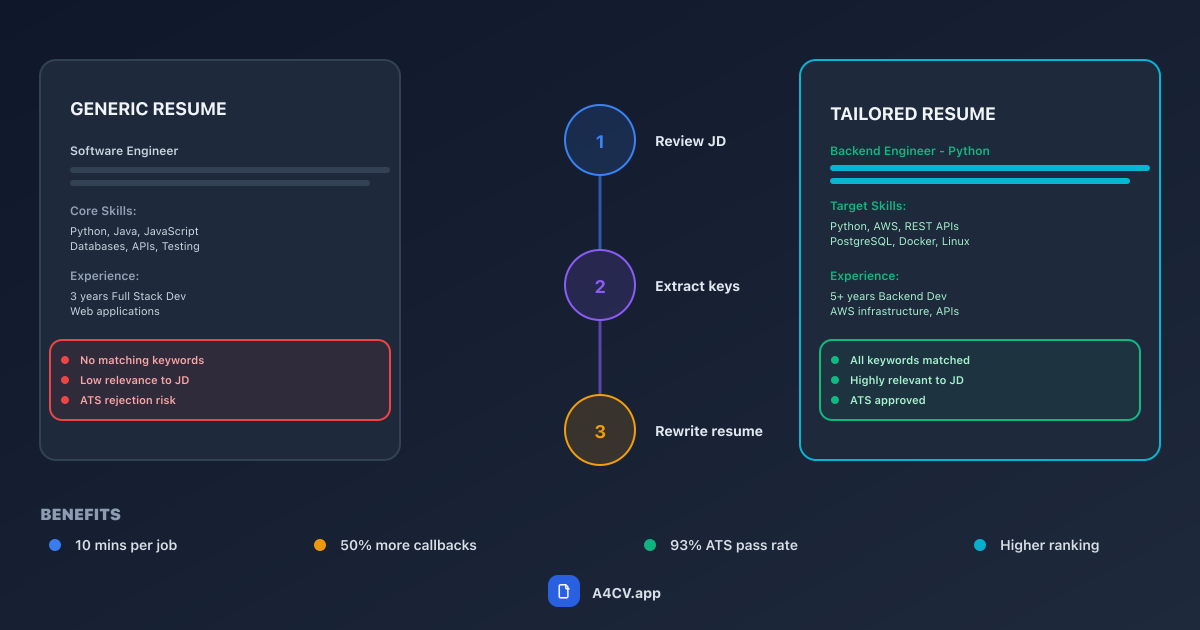
Fast tailoring focuses on the four elements recruiters see first: headline, top bullets, skills, and job title emphasis.
The tailoring question you need to answer
You're applying to 20 roles. You don't have time to rewrite your resume 20 times.
The real question: What's the minimum change that signals "I'm right for this job" to a recruiter in the first 6 seconds?
The answer: Update your headline, reorder your top bullets, and adjust your skills section. That's it. Those three changes take 10 minutes and account for most of the difference between "generic resume" and "tailored resume."
The math of tailoring
Your resume gets skimmed in 6–8 seconds. In that time, a recruiter sees:
- Your headline (2 seconds)
- Your most recent role (3 seconds)
- Your skills section (2 seconds)
They don't spend 10 minutes reading your entire background. They spend 6 seconds getting the gestalt: "Is this person positioned for this job?"
Tailoring for those 6 seconds is the move.
The four changes that matter
1. Update your headline (2 minutes)
Your current headline is probably generic:
❌ "Software Engineer" ❌ "Product Manager" ❌ "Senior Designer"
Change it to match the job posting's language:
✓ "Senior Product Manager · Growth & Activation" ✓ "Backend Engineer · Distributed Systems at Scale" ✓ "Product Designer · B2B SaaS"
The headline is the first thing anyone sees. Make it specific to this job.
2. Reorder or rewrite your top 2–3 bullets (5 minutes)
Most resumes list experience in chronological order: most recent first. Fine.
For tailoring, your most relevant role isn't always your most recent. Look at the job posting. Which of your past roles is closest to this one?
Put that role first, or bump its most relevant bullets to the top.
Example:
You're applying for a "Growth Product Manager" role. Your current resume lists:
Current Role: Marketing Manager, 2024–Present Previous Role: Product Manager (Growth), 2021–2024 Earlier Role: Product Manager (Platform), 2019–2021
Move the "Growth PM" role to the top. If that role is buried, pull its strongest bullets forward.
Better yet: rewrite the bullets to emphasize growth outcomes:
❌ "Worked on growth initiatives and product features."
✓ "Led growth experimentation framework; tested 40+ hypotheses, shipped 8 winning features that increased activation by 18% and reduced churn by 5%."
The second version uses the job posting's language ("growth," "experimentation," "activation") and shows concrete outcomes.
3. Adjust your skills section (2 minutes)
Most resumes list skills alphabetically or by recency. Tailoring means prioritizing.
If the job emphasizes "PostgreSQL, React, and Docker," and your skills section lists them at the bottom under a longer list, move them to the top.
Current (generic):
Skills: Python, JavaScript, React, Node.js, PostgreSQL, MongoDB,
Docker, AWS, Git, Figma, etc.
Tailored (for this job):
Languages: Python, JavaScript
Frontend: React
Backend: Node.js
Databases: PostgreSQL
DevOps: Docker, AWS
Tools: Git
This does two things:
- It signals "I know what matters for this role" by putting the right tools at the top.
- It makes parsing easier for ATS systems — they look at the top of the skills section first.
4. Adjust role emphasis (1 minute)
If your most relevant experience isn't recent, emphasize relevance over recency.
Example: You're a marketing manager applying to a product management role. You were a PM for two years (2021–2023) but have been in marketing for two years since (2023–present).
Option A: List your current marketing role first (standard chronological). Option B: Lead with your PM background.
Leading with PM makes sense here. The interviewer will ask, "Why the move to marketing?" and you'll explain. But you've signaled expertise first.
This is tactical, not dishonest. Your PM background is real. You're just highlighting what matters for this role.
Real-world example: before and after
Job posting highlights: Senior Engineer, strong backend skills, microservices experience, scale, PostgreSQL, Go, team leadership
Your resume (before tailoring):
Software Engineer Google, 2022–Present • Shipped features in TypeScript and React • Collaborated with product team • Learned Go and helped with microservices project
Backend Engineer Stripe, 2019–2022 • Built payment processing systems • Optimized PostgreSQL database • Led small team of 3 engineers • Designed microservices for payment reconciliation
Your resume (after tailoring):
Senior Backend Engineer · Microservices at Scale Stripe, 2019–2022 • Architected microservices for payment reconciliation, handling 10M+ daily transactions; reduced query latency by 40% through PostgreSQL optimization • Led team of 3 engineers through major system redesign; mentored junior engineers on database design patterns • Designed and implemented distributed ledger system in Go to improve payment reconciliation accuracy from 99.2% to 99.99%
Google, 2022–Present • [Keep current role here, but it's less relevant for this backend-focused position]
Changes made:
- Headline: Added "Senior" and "Microservices at Scale" to match job requirements
- Role order: Led with backend experience instead of current Google role
- Bullets: Quantified impact ("10M+ transactions," "40% latency reduction," "99.2% to 99.99%"), emphasized Go and microservices, showed team leadership
- Language: Mirrored job posting ("microservices," "scale," "PostgreSQL")
This resume now signals: "I've done exactly this before, at scale, and I led people doing it."
The fast tailoring workflow
- Read the job posting. Identify 5–8 keywords that matter most. (2 minutes)
- Update headline. Match the role level and specialty. (1 minute)
- Pick your most relevant role. Could be current, could be historical. (1 minute)
- Rewrite top 2 bullets of that role to emphasize the job posting's priorities. (5 minutes)
- Reorder skills to put the job's key technologies at the top. (1 minute)
Total: 10 minutes.
Then export and apply.
When to tailor and when to skip it
Always tailor:
- When the job posting includes specific technologies or methodologies you have experience with
- When the role title or focus is different from your current position
- When you're applying to fewer than 5 roles (you have time)
You can skip tailoring:
- When the job is a direct match (same title, same skill set, obviously right for you)
- When you're bulk-applying to 20+ jobs in the same field (diminishing returns)
- When the job is clearly not a fit no matter how you frame it
Most of the time, the 10-minute tailoring is worth it. Tailored resumes get better response rates.
Tools that make tailoring faster
If you're applying to many roles:
- Keep a master resume with all your achievements, skills, and experience. Pull from this when tailoring.
- Use templates for bullets: "Led [initiative] that [outcome]; [impact metric]."
- Save custom versions for common role types: "Resume – Backend Engineer.pdf," "Resume – Technical Manager.pdf"
- Track applications in a spreadsheet: which role, which tailored version, when applied. This helps you identify patterns in which versions work.
If you're building your resume from scratch, use our templates — they're structured to make tailoring easy.
The real win
Most applicants send the same resume to every job. They look generic. You tailor in 10 minutes. You stand out.
That 10 minutes of work signals professionalism and interest. It gets your resume past the 6-second skim. That's the whole game.
Ready to tailor?
Start here: Extract the keywords from the job posting first. That gives you the list of 8–15 words to weave into your headline and bullets. Then apply the four-change workflow above.
For deeper formatting guidance, check out how to make your resume ATS-friendly — same tailoring works better when the structure is clean.
Need a concrete example of what parsers see? Use our ATS Checker to test your tailored resume before submitting.
Want a resume that reads like this article?
Open the builder and polish your resume with a live A4 preview.