How to Write Achievement-Driven Resumes (With Examples)
Hiring signal
Outcomes > tasks
Recruiters infer capability from evidence. Clear outcomes outperform long lists of duties.
An achievement-driven resume answers one question: "What changed because you were there?"
That's what hiring managers want to know. Not what you did - what happened because of it.
If your formatting is messy, strong achievements still get lost. Use the resume builder to get clean structure, then review Making Your Resume ATS-Friendly: A Practical Guide.
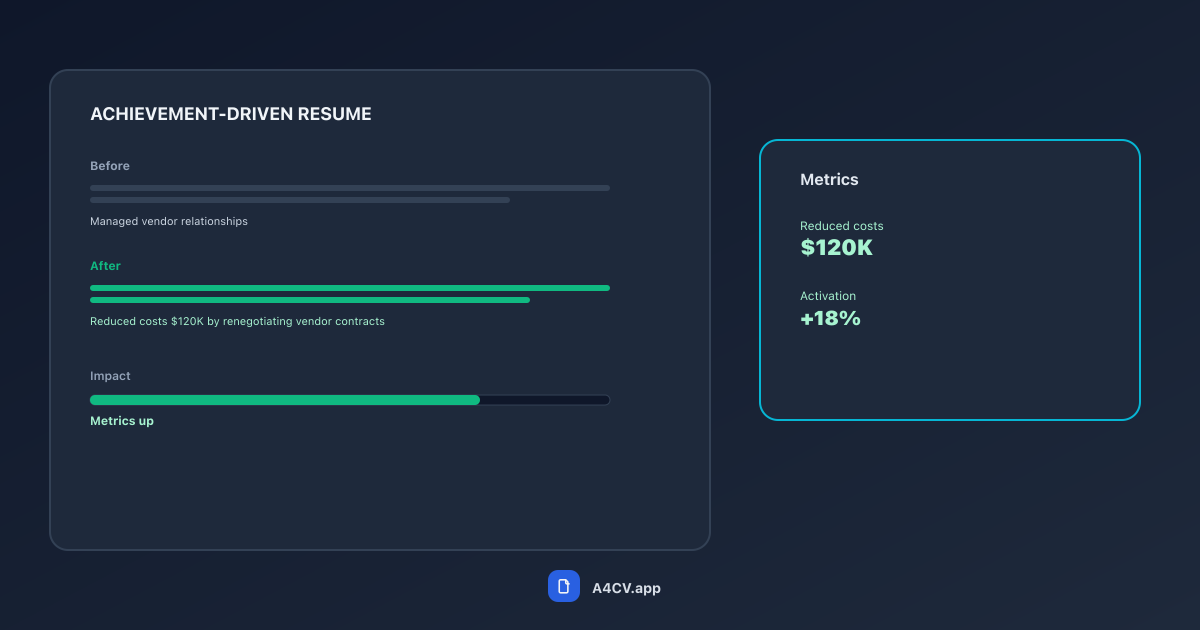
Turn vague responsibilities into specific, measurable achievements that prove your impact.
What counts as an achievement
An achievement is a measurable change: revenue, cost, time, quality, risk, or customer outcome. If you did the task but can't show the result, it reads like a responsibility.
Good achievements are specific and scoped:
- Improved a metric by a percentage or value
- Reduced time, cost, or error rate
- Delivered a project with clear impact
- Influenced a decision with measurable outcome
The difference between a responsibility and an achievement is the "so what." Responsibilities describe activity. Achievements describe results.
The achievement formula
The simplest version
Action + scope + result
"Automated monthly reporting for 12 stakeholders, cutting preparation time by 70%."
This works because it names the action, shows the scope, and quantifies the outcome.
When you need more context
Action + method + result
"Redesigned onboarding emails and A/B tested new sequences, increasing activation by 18%."
Use this when the method itself demonstrates skill or judgment.
Real before-and-after examples
Before: "Managed vendor relationships."
After: "Renegotiated vendor contracts, reducing annual costs by $120K while improving SLA response times."
The first tells you nothing. The second shows negotiation skills, cost awareness, and follow-through.
Before: "Worked on the company website."
After: "Improved site conversion by 9% by simplifying checkout and reducing page load time."
Before: "Responsible for customer support."
After: "Resolved 45+ tickets daily while maintaining 97% satisfaction rating and reducing average response time from 4 hours to 90 minutes."
Before: "Helped with marketing campaigns."
After: "Contributed to email campaign that generated $340K in pipeline, writing copy for 3 of the 5 highest-performing sequences."
Where to find your metrics
You probably have more metrics than you think. Look at:
- Project dashboards and OKRs
- Quarterly business reviews
- Support or quality reports
- Team retrospectives
- Customer feedback summaries
- Performance reviews
- Slack messages where someone thanked you for something
If your company tracks it, you can probably use it. And if you don't have exact numbers, reasonable estimates work - just be prepared to explain your methodology.
If you're early in your career, use project outcomes and academic results. If you're senior, include scope and decision-making. See Entry-Level Resume Guide: How to Stand Out with Limited Experience and A Simple Resume Checklist for Senior Roles.
Common mistakes
Listing duties without results. "Responsible for onboarding new hires" tells recruiters nothing about whether you were good at it.
Using vague verbs. "Helped" and "supported" and "assisted" are weak. Lead with stronger verbs: built, reduced, increased, launched, negotiated, designed.
Inflating numbers without context. "Increased revenue by 500%" sounds impressive until they ask about the base. $100 to $500 isn't the same as $1M to $5M.
Overloading bullets with jargon. If your bullet needs a glossary, simplify it. Clear beats clever.
More mistakes to avoid: Top Resume Mistakes That Kill Your Chances.
Best practices that keep bullets sharp
- Lead with the result when it's the most impressive part
- Keep each bullet to one outcome
- Use numbers only when they're real and defensible
- Balance metrics with clarity - a clean bullet beats a dense one
If you're deciding how much detail to include, use the same discipline as resume length. See One Page vs Two Page Resume: When Length Matters.
Achievement-driven resumes and ATS
ATS systems don't evaluate achievements. They parse them. Clear structure and standard labels make those achievements readable.
That's why ATS-friendly format matters. Review ATS Systems Explained: How to Beat Them if you're unsure.
The good news: what works for humans works for ATS. Clear bullets, standard formatting, measurable outcomes - all of it helps both audiences.
When you genuinely don't have metrics
Some work is hard to quantify. That's okay. You can still write achievement-focused bullets:
- Process improvements: "Streamlined new hire onboarding, reducing ramp time and eliminating 3 redundant training sessions"
- Quality work: "Authored technical documentation used by 40+ engineers across 3 teams"
- Collaboration: "Coordinated cross-functional launch involving engineering, design, and marketing, shipping on schedule"
The key is showing impact, even when you can't put a number on it.
FAQ
Do I need numbers in every bullet?
No. Use numbers when they strengthen the claim. Clear outcomes without numbers are still strong.
What if I don't have access to metrics?
Use proxies: time saved, volume handled, or qualitative outcomes from performance reviews. You can also estimate - "approximately 30% reduction" is better than no number at all.
Can achievements be about collaboration?
Yes. Just name the scope and the outcome so your contribution is visible. "Led cross-functional team" is vague. "Led 5-person cross-functional team that shipped payment feature used by 10K customers" is concrete.
Should I keep older achievements?
Only if they support your target role. Otherwise, trim them for focus.
What if my achievements seem small?
Small achievements are still achievements. "Reduced report generation time from 3 hours to 20 minutes" matters if it freed up time for higher-value work. Context is everything.
Why this matters
Hiring managers don't have time to guess what you accomplished. An achievement-driven resume removes that guesswork.
Every bullet becomes a signal: this person delivers results. That's the resume that gets callbacks.
Ready to rewrite your bullets? The resume builder gives you live A4 preview so you can see exactly how your achievements look on the page. Test your resume with the ATS Checker to make sure it parses correctly.
Want a resume that reads like this article?
Open the builder and polish your resume with a live A4 preview.