How to Extract Keywords from a Job Description (and Use Them Strategically)
Keyword strategy
8–15 targeted keywords
The goal isn't every word from the job posting. It's the 8–15 words that matter most, placed where a recruiter and an ATS will see them.
The job description is your resume's blueprint. Every keyword in that posting is a signal: This is what success looks like for this role.
Your job is to find the 8–15 most important keywords — the ones that appear consistently, that describe the core work, that show up in both required and preferred skills — and weave them into your resume naturally. Not as keyword spam. As proof that you understand the role and have done it before.
This guide shows you how to extract those words in 10 minutes and place them where they'll be seen — by ATS parsers and by humans reading your resume in a 6-second skim.
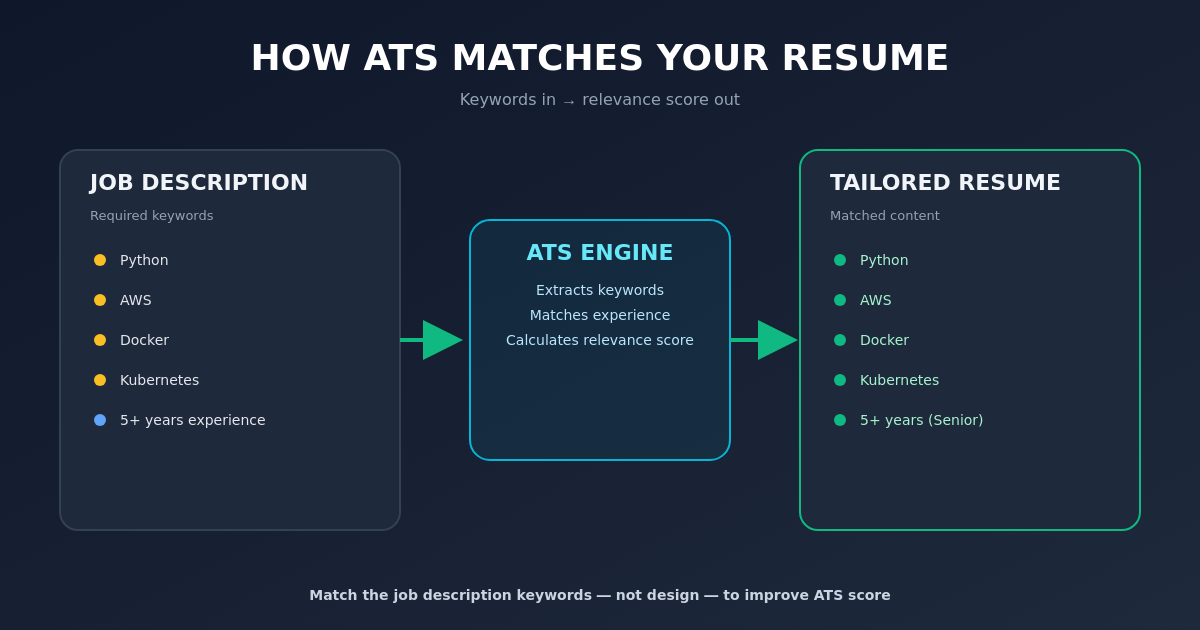
Extract the core 8–15 keywords from the job posting and redistribute them through your headline, experience bullets, and skills section.
Why keyword matching works
Recruiters and ATS systems both look for the same signal: Can this person do this job using language the job description uses?
An ATS isn't looking for magic keywords. It's looking for proof you can do the work. When a job posting lists "project management" and your resume lists "managed cross-functional projects," you're using their language. That alignment matters to both the machine and the human.
The key is choosing the right words — not every word in the posting, and definitely not keyword stuffing. Eight to fifteen strategic words beats fifty scattered ones.
How to find the keywords that matter
Open the job posting and read it like a recruiter would. Look for:
Required skills and tools. "Must have: React, Node.js, PostgreSQL." Those are keywords. Use them if you actually have them.
Repeated phrases. If the posting mentions "collaborative" three times, that's a keyword. They care about teamwork.
Job-specific language. A data scientist role talks about "experimentation," "statistical modeling," and "metrics." A product role talks about "roadmaps," "user feedback," and "shipping." Mirror their vocabulary.
Role-level terms. "Senior Engineer," "Product Manager," "Technical Lead" — these matter. Use the exact title if it matches your background.
Business outcomes they mention. "Drive growth," "reduce churn," "increase conversions," "improve retention" — these show what success looks like to them.
Here's a real example:
Job posting (excerpt):
We're looking for a Senior Product Manager to own growth initiatives. You'll collaborate with design, engineering, and marketing to ship features that drive user activation. Experience with data-driven decision-making and A/B testing is critical. You should have a track record of launching products and growing user bases.
Keywords to extract:
- Senior Product Manager
- Growth initiatives
- Cross-functional collaboration (implied from design, engineering, marketing)
- User activation
- Data-driven decision-making
- A/B testing
- Shipping features
- User growth
That's 8 keywords. Concrete. Extractable from the job posting. Not all of them are in the posting word-for-word — "cross-functional collaboration" is implied, "shipping features" is paraphrased — but they capture the intent.
Where to place keywords for impact
Placing keywords randomly throughout your resume doesn't work. They need to appear in places where humans and ATS systems actually look:
1. Your headline or title. This is the first thing anyone sees.
If the job is "Senior Product Manager – Growth," your headline should be similar:
- Good: "Senior Product Manager · Growth & User Activation"
- Bad: "Resume of someone who works at companies"
2. The opening bullets of your most relevant role. Your top 3 bullets should demonstrate the outcomes the job posting prioritizes.
If the job emphasizes data-driven decision-making and A/B testing, your first bullet in a relevant role might be:
"Led A/B testing program across onboarding flows; tested 12 hypotheses, implemented 8 winners that increased activation by 18%."
This places three keywords (A/B testing, onboarding, activation) in a high-visibility bullet with concrete proof.
3. Your skills section, near the top. Put the 5–8 most relevant keywords there.
4. Your summary or profile (if you have one). A tight one-liner that includes the role title and a key keyword:
"Senior Product Manager passionate about growth and user activation. Track record shipping products that scale."
Avoid keyword stuffing
Keyword stuffing — repeating words unnaturally or cramming them in without context — is obvious and hurts you:
❌ Bad (stuffed): "I have extensive experience with A/B testing and user activation and growth and data-driven decisions about user activation and A/B testing to drive activation."
✓ Good (integrated): "Implemented A/B testing framework that validated 40+ product hypotheses; drove 25% increase in user activation through data-driven iteration."
The second version uses the keywords naturally because they're part of a real achievement.
A practical extraction workflow (10 minutes)
- Copy the job posting into a document.
- Skim and highlight tools, skills, and repeated phrases.
- List them out, including the exact wording when it's specific ("React" not "modern frameworks").
- Group similar items (agile, scrum, sprint planning → "agile methodology").
- Prioritize must-have vs. nice-to-have.
- Count to 15. If you have more than 15, drop the weakest.
- Map them to your resume: Where does each keyword appear? Headline? First bullet? Skills section?
- Rewrite one relevant role to include 3–4 of the top keywords naturally.
Common keyword mistakes
Fabricating experience. If the job asks for Python and you've never coded in Python, don't add it. ATS systems might get you in the door, but the interview will expose the lie immediately. Add Python only if you actually know it.
Using vague keywords. "Leader," "team player," "problem solver" are everywhere. Specific keywords matter more: "Scrum master," "technical debt reduction," "CI/CD pipeline."
Forgetting to customize. Using the same resume for every application means most keywords don't match the job posting. Spend 10 minutes extracting keywords and updating your headline and top bullets. That's enough to signal alignment.
Putting keywords only in skills section. Skills sections are skimmed. Bullets are read. Put your strongest keywords in your strongest bullets.
Real resume examples
Example 1: Product Manager applying to growth role
Job posting emphasizes: "Growth," "user activation," "A/B testing," "retention," "analytics"
Resume changes:
- Headline: "Senior Product Manager · Growth & Activation"
- First bullet in relevant role: "Led A/B testing initiative across onboarding, increasing user activation by 18%; currently optimizing for retention"
- Skills: Add "Growth analytics," "A/B testing," "Retention optimization" near the top
Example 2: Engineer applying to backend role
Job posting emphasizes: "Microservices," "PostgreSQL," "scale," "distributed systems," "API design"
Resume changes:
- Headline: "Senior Backend Engineer · Microservices at Scale"
- First bullet: "Architected microservices layer supporting 10M+ requests/day; optimized PostgreSQL schema for 40% query performance improvement"
- Skills: "Microservices," "PostgreSQL," "API design," "Distributed systems" in the top 5
Testing your keyword alignment
Use the ATS Checker to see if your extracted keywords are being picked up:
- Upload your updated resume.
- Look at what skills the parser extracted.
- If your target keywords aren't showing up, adjust wording or placement.
- Repeat until your top keywords appear.
This takes 5 minutes and tells you whether your keyword strategy is working at the parsing level.
The goal
You're not trying to game the system. You're communicating clearly. When a job poster says "A/B testing" and your resume says "A/B testing," that's clarity. It tells the recruiter and the ATS: "I know what this job needs, and I have it."
What's next?
Once you've extracted keywords, move through this sequence:
-
Learn the 4 high-leverage changes that signal alignment (headline, top bullets, skills order, role emphasis). Most tailoring happens in 10 minutes.
-
Make sure the formatting works — clean single-column layout, standard fonts, parseable structure. Good format + your keywords = resume that passes ATS and impresses humans.
-
Test it — upload to our ATS Checker and verify the system extracted your skills correctly.
That sequence (keywords → tailoring → formatting → testing) is the fastest path to getting past screening.
Want a resume that reads like this article?
Open the builder and polish your resume with a live A4 preview.